
Specifying Aerosols and Clouds#
import sasktran2 as sk
import numpy as np
import matplotlib.pyplot as plt
Aerosols and clouds in sasktran2 are specified through a combination of two things:
The amount of aerosol/cloud, this could be a vertical optical depth, extinction at a given reference wavelength, or a number density
The optical properties of the scatterer
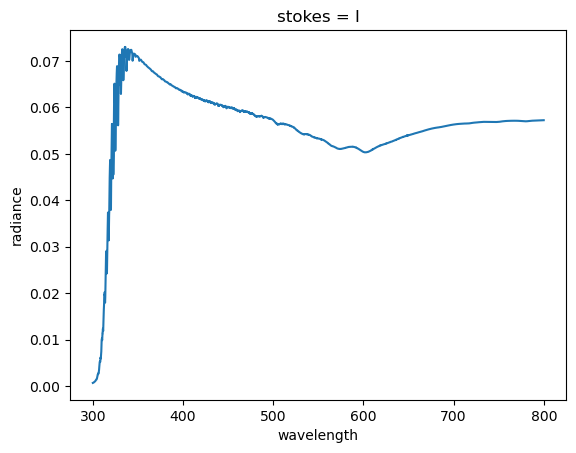
As an example, we will start with a clear sky radiative transfer calculation and add in a cloud,
import sasktran2 as sk
import numpy as np
import matplotlib.pyplot as plt

config = sk.Config()
config.multiple_scatter_source = sk.MultipleScatterSource.DiscreteOrdinates
config.num_streams = 2
config.delta_m_scaling = True

altitude_grid = np.arange(0, 65001, 1000)

model_geometry = sk.Geometry1D(cos_sza=0.6,
                               solar_azimuth=0,
                               earth_radius_m=6372000,
                               altitude_grid_m=altitude_grid,
                               interpolation_method=sk.InterpolationMethod.LinearInterpolation,
                               geometry_type=sk.GeometryType.PlaneParallel)

viewing_geo = sk.ViewingGeometry()

viewing_geo.add_ray(
    sk.GroundViewingSolar(
        cos_sza=0.6,
        relative_azimuth=0,
        cos_viewing_zenith=0.8,
        observer_altitude_m=200000,
    )
)

wavel = np.arange(300, 800, 0.1)
atmosphere = sk.Atmosphere(model_geometry, config, wavelengths_nm=wavel)

atmosphere.surface.albedo[:] = 0.3

sk.climatology.us76.add_us76_standard_atmosphere(atmosphere)

atmosphere["rayleigh"] = sk.constituent.Rayleigh()
atmosphere['ozone'] = sk.climatology.mipas.constituent("O3", sk.optical.O3DBM())
atmosphere['no2'] = sk.climatology.mipas.constituent("NO2", sk.optical.NO2Vandaele())

engine = sk.Engine(config, model_geometry, viewing_geo)

radiance_no_cloud = engine.calculate_radiance(atmosphere)

radiance_no_cloud["radiance"].isel(los=0).plot()
[<matplotlib.lines.Line2D at 0x7c24505a57f0>]
Next, we will create an optical property by specifying the single scattering albedo and asymmetry factors,
wavel = np.arange(300, 801, 10.0)
xsec = np.ones_like(wavel)
ssa = np.ones_like(wavel) * 1.0
g = np.ones_like(wavel) * 0.75

hg = sk.optical.HenyeyGreenstein.from_parameters(
    wavelength_nm=wavel,
    xs_total=xsec,
    ssa=ssa,
    g=g,
)
And we will specify the cloud with a Gaussian height profile and add it to the atmosphere,
cloud = sk.constituent.GaussianHeightExtinction(
    optical_property=hg,
    height_m=2000,
    width_fwhm_m=500,
    vertical_optical_depth=10,
    vertical_optical_depth_wavel_nm=550,
    altitudes_m=altitude_grid,
)

atmosphere["cloud"] = cloud
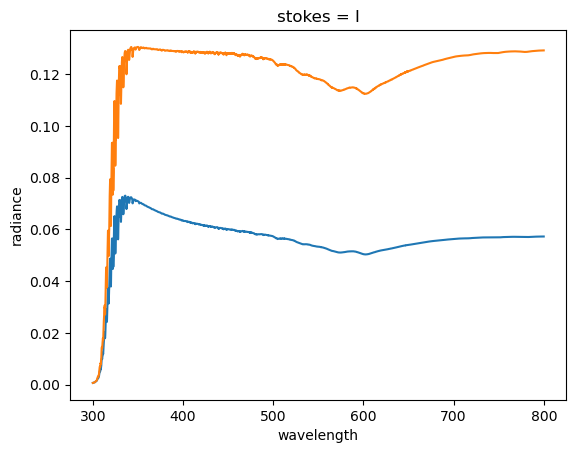
Then we can rerun the calculation
radiance_cloud = engine.calculate_radiance(atmosphere)

radiance_no_cloud["radiance"].isel(los=0).plot()
radiance_cloud["radiance"].isel(los=0).plot()
[<matplotlib.lines.Line2D at 0x7c245060a540>]
Scatterer optical properties#
The following are the supported ways to specify the optical properties of scatterers.
An optical property that uses a Henyey-Greenstein phase function. |
|
Baum V3.6 severely rough ice-crystal optical properties. |
|
|
A purely scattering optical property defined by a database file. |
Mie scattering optical property where the Mie calculations are done on the fly. |
|
|
A MieDatabase is a database that caches Mie scattering data on the local file system. |
Baum ice-crystal database#
sasktran2.optical.BaumIceCrystal provides the severely rough Baum
V3.6 ice-crystal tables for effective diameters from 10 to 120 microns and
wavelengths from 199 to 99,000 nm. Select the effective diameter at each
constituent altitude using the effective_diameter_um keyword:
ice = sk.optical.BaumIceCrystal(
    particle_model="general_habit_mixture",
    max_moments=256,
)
atmosphere["ice"] = sk.constituent.ExtinctionScatterer(
    ice,
    altitude_grid,
    extinction_per_m,
    extinction_wavelength_nm=550.0,
    effective_diameter_um=effective_diameter_um,
)
The standard database is distributed as two files. The default and any
max_moments value up to 256 retrieve the smaller 256-moment file. Values above
256 retrieve the several-gigabyte, 16,384-moment file and load only the requested
prefix. Setting max_moments=None retrieves the full file and loads all 16,384
stored moments, which can require several gigabytes of memory. Passing db_filepath
always uses that exact local file and does not retrieve either standard-database
artifact.
The large file is a fixed-cap expansion rather than a guarantee that every source
phase matrix has converged by 16,384 moments. Sharply peaked short-wavelength cases
can reach the cap first. The file records these cases in
phase_reconstruction_converged and includes the worst reconstruction errors in
its global attributes.
Scattering Constituents#
The following are the supported ways to specify the amount of scatterers.
A scattering constituent that is defined by a number density on an altitude grid and an optical property |
|
A Geometry2D scatterer normalized to an extinction profile. |
|
A scattering constituent that is defined by a number density on an altitude grid and an optical property |
|
A scatterer specified by number density on a Geometry2D grid. |
|
A constituent that is defined by a gaussian-shaped extinction profile. |