

Calculating Fluxes#
Fluxes can be internally calcluated in sasktran2 by specifying a location to calculate
the fluxes at with the sasktran2.ViewingGeometry.add_flux_observer() method.
Note
Currently flux output is only supported when using the DiscreteOrdinates source, in PlaneParallel mode, i.e.
config = sk.Config()
config.single_scatter_source = sk.SingleScatterSource.DiscreteOrdinates
config.multiple_scatter_source = sk.MultipleScatterSource.DiscreteOrdinates

model_geometry = sk.Geometry1D(...,
                               geometry_type=sk.GeometryType.PlaneParallel)


# Thermal sources can also be included when performing flux calculations by adding

config.emission_source = sk.MultipleScatterSource.DiscreteOrdinates
Flux calculations are setup the exact same way as standard radiance calculations, except we tell the the model to output fluxes instead of radiances. For example,
import sasktran2 as sk
import numpy as np
import matplotlib.pyplot as plt

config = sk.Config()
config.single_scatter_source = sk.SingleScatterSource.DiscreteOrdinates
config.multiple_scatter_source = sk.MultipleScatterSource.DiscreteOrdinates

config.num_streams = 2
config.delta_m_scaling = True
config.num_forced_azimuth = 1

model_geometry = sk.Geometry1D(cos_sza=0.6,
                               solar_azimuth=0,
                               earth_radius_m=6372000,
                               altitude_grid_m=np.arange(0, 65001, 1000),
                               interpolation_method=sk.InterpolationMethod.LinearInterpolation,
                               geometry_type=sk.GeometryType.PlaneParallel)

viewing_geo = sk.ViewingGeometry()

# Add a flux observer at every layer boundary
for alt in model_geometry.altitudes():
    viewing_geo.add_flux_observer(
        sk.FluxObserverSolar(0.6, alt)
    )

wavel = np.arange(280, 2000, 1.0)
atmosphere = sk.Atmosphere(model_geometry, config, wavelengths_nm=wavel)

atmosphere["surface"] = sk.constituent.LambertianSurface(0.3)

sk.climatology.us76.add_us76_standard_atmosphere(atmosphere)

atmosphere["rayleigh"] = sk.constituent.Rayleigh()
atmosphere['ozone'] = sk.climatology.mipas.constituent("O3", sk.optical.O3DBM())
atmosphere['no2'] = sk.climatology.mipas.constituent("NO2", sk.optical.NO2Vandaele())

atmosphere['solar'] = sk.constituent.SolarIrradiance(mode="average")

engine = sk.Engine(config, model_geometry, viewing_geo)

rad = engine.calculate_radiance(atmosphere)

# TOA Flux
rad["upwelling_flux"].isel(flux_location=-1).plot()
[<matplotlib.lines.Line2D at 0x789f4ec76990>]
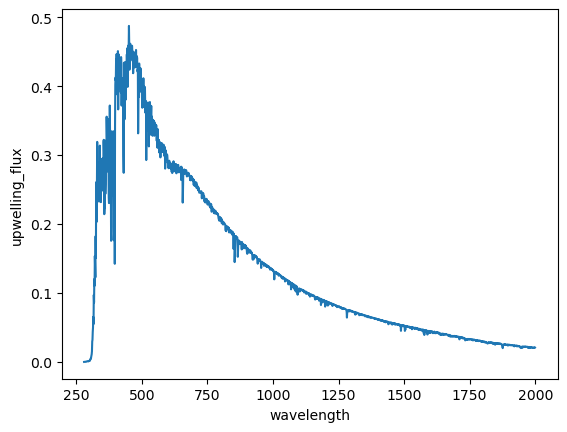
By default both upwelling and downwelling fluxes are calculated for every “flux observer” location.
print(rad)
<xarray.Dataset> Size: 545MB
Dimensions:                                (wavelength: 1720, los: 0,
                                            stokes: 1, flux_location: 66,
                                            altitude: 66, no2_altitude: 50,
                                            ozone_altitude: 50,
                                            surface_wavelength: 1)
Coordinates:
  * wavelength                             (wavelength) float64 14kB 280.0 .....
  * stokes                                 (stokes) <U1 4B 'I'
Dimensions without coordinates: los, flux_location, altitude, no2_altitude,
                                ozone_altitude, surface_wavelength
Data variables: (12/21)
    radiance                               (wavelength, los, stokes) float64 0B
    upwelling_flux                         (wavelength, flux_location) float64 908kB ...
    downwelling_flux                       (wavelength, flux_location) float64 908kB ...
    wf_temperature_k                       (altitude, wavelength, los, stokes) float64 0B ...
    wf_pressure_pa                         (altitude, wavelength, los, stokes) float64 0B ...
    wf_specific_humidity                   (altitude, wavelength, los, stokes) float64 0B ...
    ...                                     ...
    wf_ozone_vmr_upwelling_flux            (ozone_altitude, wavelength, flux_location) float64 45MB ...
    wf_ozone_vmr_downwelling_flux          (ozone_altitude, wavelength, flux_location) float64 45MB ...
    wf_no2_vmr_upwelling_flux              (no2_altitude, wavelength, flux_location) float64 45MB ...
    wf_no2_vmr_downwelling_flux            (no2_altitude, wavelength, flux_location) float64 45MB ...
    wf_surface_albedo_upwelling_flux       (surface_wavelength, wavelength, flux_location) float64 908kB ...
    wf_surface_albedo_downwelling_flux     (surface_wavelength, wavelength, flux_location) float64 908kB ...
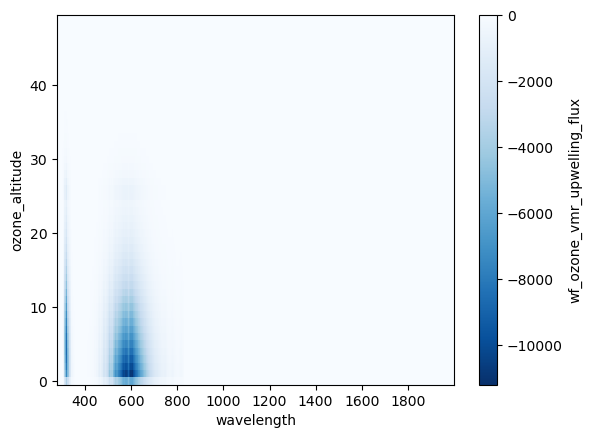
In addition, derivatives of the flux with respect to the input atmospheric parameters are calculated. E.g. we can look at how changes in ozone influence the TOA outgoing spectral flux,
rad["wf_ozone_vmr_upwelling_flux"].isel(flux_location=-1).plot(y="ozone_altitude", cmap="Blues_r")
<matplotlib.collections.QuadMesh at 0x789f4ecc9550>
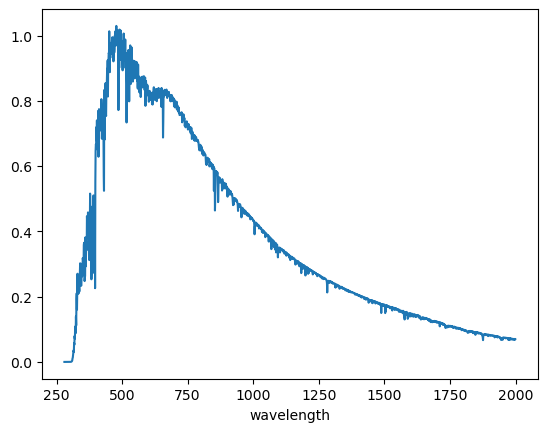
Or how the surface albedo influences the net flux at TOA,
(rad["wf_surface_albedo_upwelling_flux"] - rad["wf_surface_albedo_downwelling_flux"]).isel(flux_location=-1).plot(x="wavelength")
[<matplotlib.lines.Line2D at 0x789f4e999d90>]
Note
By default, the flux calculation includes the downwelling flux from the direct solar beam. To disable this you can set
config.single_scatter_source = sk.SingleScatterSource.NoSource